
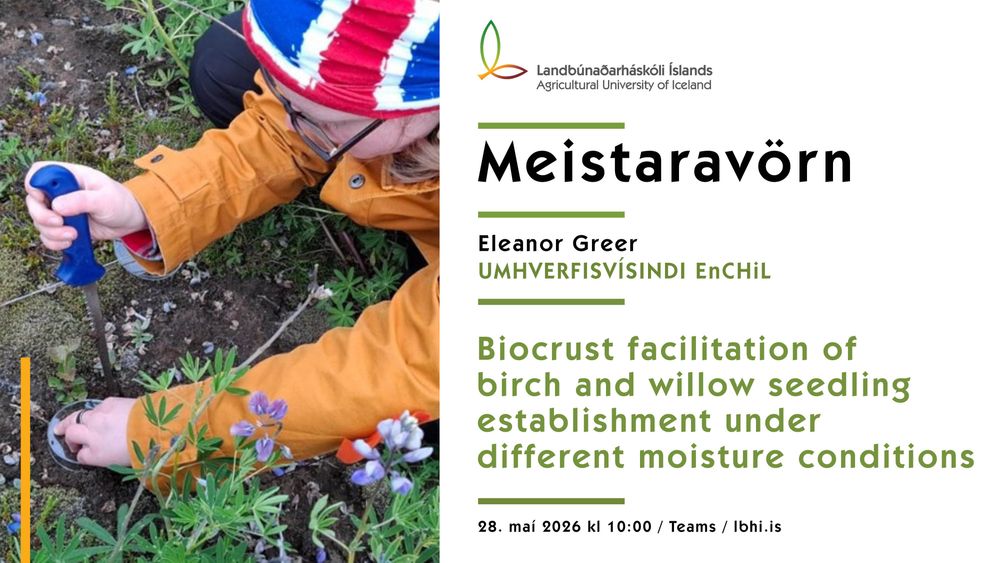
We welcome everyone to attend the open defense of the MS-EnCHiL student Eleanor Greer, which will take place on May 28th, at 10-11:30 am, Icelandic time.
Thesis title: Biocrust facilitation of birch and willow seedling establishment under different moisture conditions
Supervisors: Alejandro Salazar (main supervisor), Kristín Svavarsdóttir, Ása L. Aradóttir.
Program: Double-degree Nordic Master program in Environmental Changes at Higher Latitudes (EnCHiL). In Eleanor‘s case, her two degrees come from Lund University and the Agricultural University of Iceland.
Eleanor Greer and her external examiner, Dr. Lettice Hicks, from Lund University, will be in Sweden, so the defense will de done online. See below a summary of Eleanor‘s thesis.
Abstract
Biological soil crust (biocrust) can increase seedling establishment of vascular plants. Because of this and other biocrust functions, this soil community has been increasingly studied as a potential tool for assisting ecological restoration. However, the relationships between biocrusts and vascular plants appear to be context dependent. In the case of Betula pubescens ssp. tortuosa (mountain birch), and Salix phylicifolia (tea-leaf willow), seedling germination and establishment may be more successful on biocrust substrates than on bare ground in degraded sites. To utilize biocrusts in land restoration, it is necessary to understand the relevant biological mechanisms and their interactions with environmental conditions.
The aim of this study is to assess if biocrusts can improve germination conditions for B. pubescens ssp. tortuosa and S. phylicifolia, both target species in birch woodland restoration, under different moisture conditions, including drought and flooded conditions.
I did an experiment to assess the influence of substrate (biocrust and bare ground), moisture treatment, and site of origin on different response variables like number of seedling emergence, height, and aboveground biomass. Birch and willow seeds were incubated on biocrust and bare soil substrates from three sites under three simulated moisture regimes: drought conditions (‘dry’), semi-flooded (‘wet’), and a third moisture regime where the substrate was neither flooded nor desiccated (‘intermediate’). Substrate moisture content was also measured to assess the effect of biocrust on aspects of surface hydrology like infiltration and absorption.
My findings show that biocrust increased substrate moisture content in two treatments, intermediate and flooded conditions, and that, when compared to bare soil from the same site, biocrust shows promise for mitigating the negative effects of flooding on seedling establishment.
Keywords: Biological soil crust (biocrust), germination, seedling establishment, restoration, soil moisture.