
- Home
- News
- Open Master Thesis Presentation: Luisa Malin Wassermann - Environmental Changes at Higher Latitudes (EnCHiL)
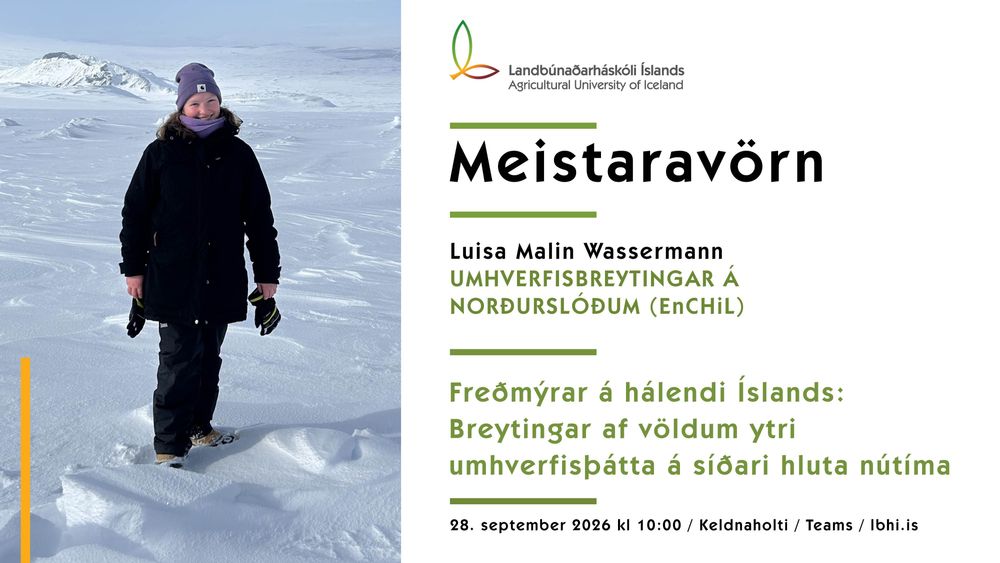
We invite everyone to attend the open master's defense of Luisa Malin Wassermann in Environmental Changes in the Arctic (EnCHiL), which will take place on September 28, 2026, at 10:00 AM.
Thesis title:
External forcings upon lithalsa mires in the Icelandic highlands: a long-term perspective
Supervisors: Susanne Claudia Möckel (LBHÍ) & Egill Erlendsson (HÍ)
Examiner: Karl Ljung (LU)
Abstract:
en: Icelandic lithalsa mires are shaped by a complex interplay of natural and anthropogenic external forcings over long timescales. They are unique permafrost landforms in a soil environment with aeolian and volcanic influence. They can serve as important archives of the environmental variations throughout the Holocene. However, little is known about the long-term response of Icelandic lithalsas to the interacting forcings of climatic variability, volcanic activity and human impact. This study investigates the influence of environmental changes on the formation and degradation of Icelandic lithalsas using a palaeoecological multi-proxy approach across the three landforms lithalsa, degraded lithalsa and fen at two areas in the Icelandic highlands. Volcanic eruptions, climatic fluctuations, and post-settlement land degradation all influenced the soil proxy records, with tephra deposition acting as the dominant disturbance forcing. Carbon accumulation declined during periods of volcanic and climatic instability and recovered during more stable intervals. A continuous gradient from lithalsas to fens reflects the progressive increase in carbon sequestration capacity associated with permafrost degradation. A multi-proxy approach is necessary to reflect and understand the overlapping volcanic, climatic, and geomorphological signals. The landform transition sequence documented here serves as a direct analogue for the future trajectory of Icelandic highland permafrost under ongoing warming. While warmer conditions may temporarily enhance carbon sequestration in fen systems, they are a long-term threat to lithalsas, whose stability depends on persistently low ground temperatures. By connecting pedological and chronological records across contrasting landforms and areas, this study advances the understanding of how Icelandic lithalsa mires respond to external forcings over the Holocene.
Keywords: Permafrost, Tephra, Aeolian deposition, Settlement, Carbon accumulation